

I don’t know how many times I’ve seen a picture in my bedroom. It’s a grainy black-and-white photo of Jim Clark sitting in the cockpit of a Lotus 25 at Silverstone. His hands are on the wheel like he always was. Clark had been deceased for a while by the time I arrived in this world, yet he was still very much alive in my home. He was more than just a driver to me. He proved that a Scottish farmer in a weak green car could beat Ferrari and make it look easy, showing that calm genius can beat overwhelming force.
In the 80’s, I was infatuated with two things: Action Heros and Fast Cars. My bedroom wall has a shrine for everything with a mid-engine arrangement. Of course, there was the Countach poster that every child has. But I also had a cutaway drawing of the Lotus Esprit Turbo that I had taken out of a magazine and stuck next to the window. I was probably eight or nine years old. I recall my brother gazing at it and nodding like he was saying, “You finally did something right.” “That’s a nice car,” he said. He didn’t mention that about the Lamborghini.
Then, in 1996, something happened that felt like it was meant for me. When I was sixteen and just learning to drive, Lotus came out with the Elise. It was hard to imagine that this roadster weighed less than a ton and looked like nothing else on the road. It was so light and pure. I fell in love with Chapman’s philosophy of “simplify, then add lightness” when it came to life for a new generation. I told myself that I would own one someday. I have been collecting cars for a long time. I’ve always enjoyed German, Italian, and American sports cars, and my wife puts up with me, but there was always a vacant bay. Not in a bodily way. In a spiritual way. I wanted a flower called a Lotus. I had to get a Lotus. The problem was that Lotus had been creating cars for decades that seemed like they had been thrown together in a hurry, even though they were well-engineered.
The first time I saw an Exige S was in 2014. I was thirty-four, which was old enough to know better but still young enough to not care. I went to a dealer in Southern California, got in it, and my heart started to race. The mid-engine layout, the supercharged Toyota four-cylinder screaming behind my head, and the feeling that every extra gram had been tracked down and slain were all very exhilarating. After that, I looked at the gaps between the panels. I ran my fingertips along the dashboard where the trim met the center console and felt a hump that would have made a kit car look terrible. The door cards were as robust as a box of cereal. I wanted to enjoy it. I truly did. But I had just spent the weekend in a Cayman, and the difference in build quality wasn’t a small one; it was a huge one.

The second car was an Elise, the same automobile that got me interested in cars when I was an adolescent. A friend of mine still had one and he was kind enough to let me drive it around some country roads. The frame was not from this planet. I had never heard a car communicate to me like that before. The steering column caught up every little variation in the warmth of the tarmac, every pebble, and every ripple. It was almost like Chapman’s ideas lived on in that car. But when I got out, my elbow hit the door panel, and the whole thing bent like a diving board. The soft top had a hole in it. The heater operated at times. These things weren’t dealbreakers for a toy car I wanted to play with on the weekends, but they were for a real automobile I wanted to own and drive all the time? I wasn’t able to do it. Not right now in my life.”They had found and killed every extra gram. It was a lot of fun. After that, I checked out the spaces between the panels.
Then I waited. I kept the bay clear. In 2021, when I was 41, Lotus showed the Emira to the world. I sat down when I saw the Emira for the first time in images. Not because I felt overwhelmed, even though I was, but because I had to learn it. Lotus had never done something like this with the proportions before. It was broader, more planted, and more aggressive, but it still retained the same mid-engine Lotus form that has been around since the Esprit and the Europa. The back haunches had a muscular flair that reminded me of the Evora GT, but the front end was brand new: cutting and predatory, with LED headlamps that gave it a modern intensity without sacrificing the brand’s subtle DNA. It looked like a car that could park next to a McLaren or a Porsche and not feel ashamed for the first time in decades. I remembered the Esprit Turbo cutaway that was on the wall in my bedroom. There was no question about the bloodline.
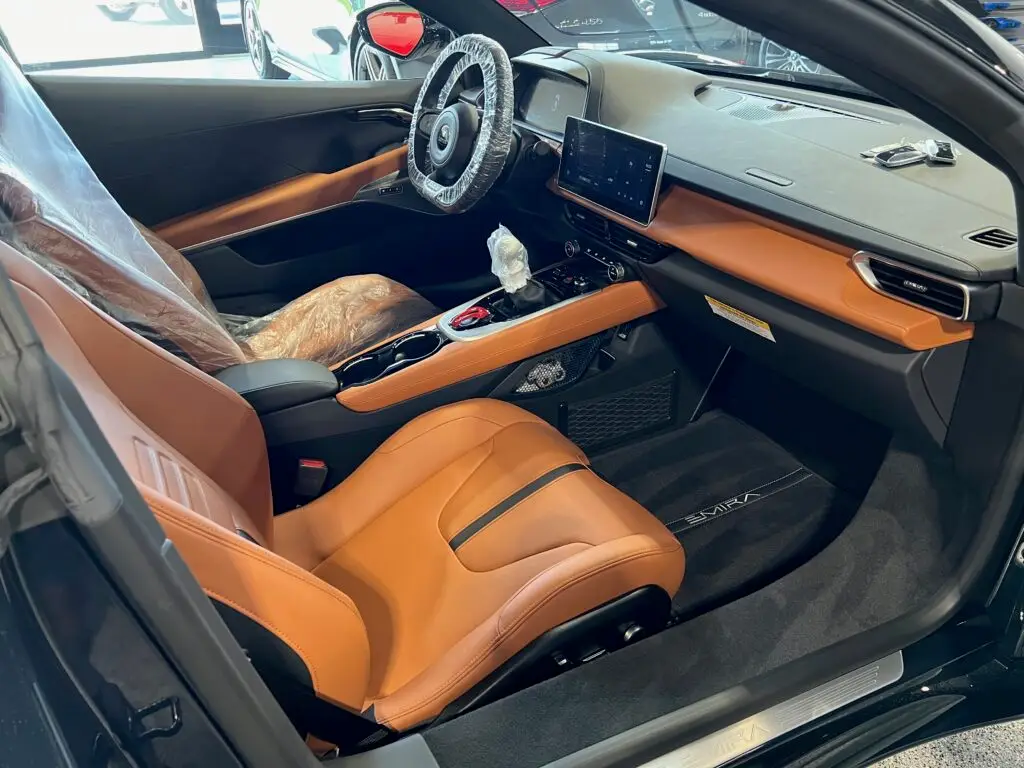
But I had been hurt in the past. It wasn’t how they looked that was the problem. The question was whether Lotus had finally fixed the problem that had kept my checkbook in my pocket for twenty years. So I waited for the reviews. I watched all of the press launch videos. I read all of the tests that lasted a long time. Everyone agreed, albeit it took some time: the Emira was different. The inside was quite wonderful. Not “good for a Lotus,” just good. The leather was real. The switchgear was made by Mercedes and Toyota. The system for entertainment and information did work. The panels didn’t have a lot of space between them. The doors didn’t rattle like they did in the past; instead, they closed with a satisfying clunk. Lotus did something that, to be honest, a lot of us weren’t convinced they could do: they produced a real GT sports car without sacrificing who they are.
The V6 First Edition is the only one I would ponder about. It seemed appropriate to purchase the 3.5-liter supercharged V6 from Toyota, which Lotus tweaked to give it 400 horsepower. It also meant that a six-speed manual was available, and the thought of changing through ratios in the last combustion Lotus felt less like a choice and more like a necessity. I had been waiting for this car for 44 years. I wasn’t going to let a pair of paddle shifters ruin my pleasure. I sat in the driver’s seat for five minutes before I pushed the start button. I turned the steering wheel, which was wrapped with leather. I opened and closed the console in the middle. I pressed every button on the screen. I was hoping for the classic Lotus that might show up in a misaligned seam or a panel that sounded empty. It wasn’t there. The interior was comfortable but not too small, and the way the seat was created made it evident that a real person had sat in it during development and remarked, “Move that switch two centimeters to the left.” The computerized instrument cluster was easy to read. The climate control worked. These sound like basic requirements, and they are, but for someone who has loved Lotus from afar for almost forty years, they felt like a tremendous adjustment.
Then I drove it.
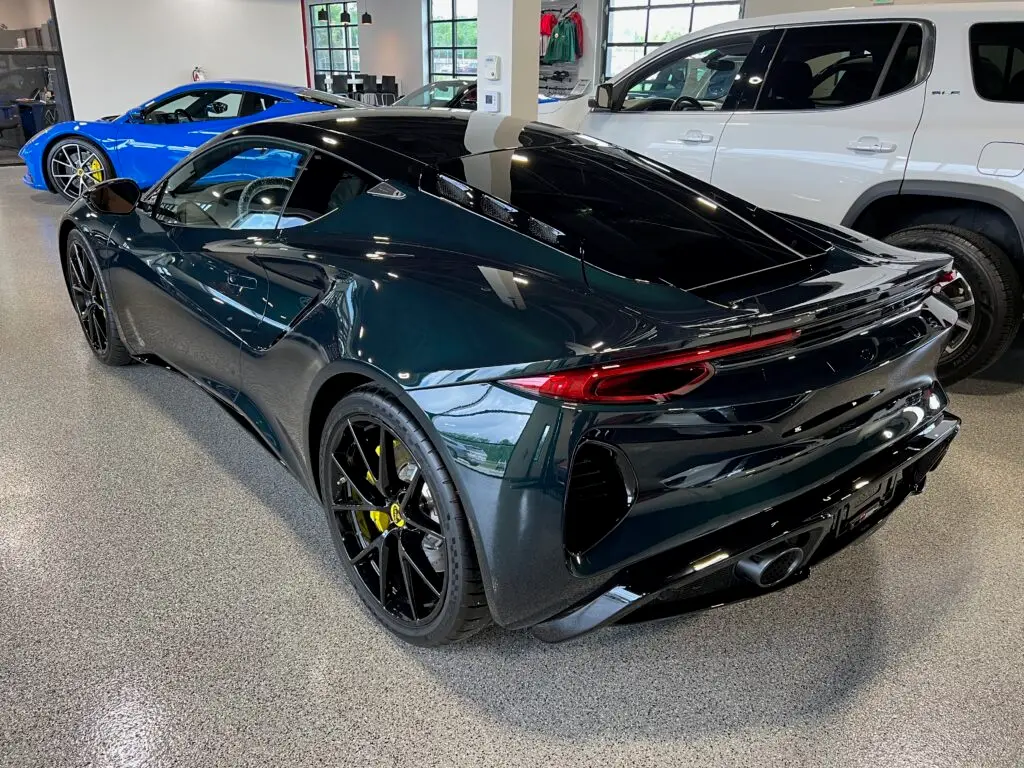
The V6 starts with a bark that develops into a low, mechanical hum. The supercharger whining grows louder as you go up in rpm. Around 4,500 rpm, it becomes the main sound: a rising, anxious cry that lets you know the car is just getting started. The six-speed manual has a short, crisp throw and a tiny bit of mechanical resistance at the gate, which makes each shift feel planned. You don’t want to keep this transmission in sixth gear on the freeway. It wants to get things done.The supercharger whine sounds like a high-pitched, frantic howl that lets you know the car is just getting started.
But the frame. Oh my gosh, the frame. Lotus has always lived here, and the Emira shows that they are still going strong. The aluminum tub is rigid and responsive, which makes the car feel like an extension of your neurological system. The turn-in is swift and smooth, and there isn’t any artificial weight like some modern sports cars use to make it feel like you’re getting feedback. The Emira doesn’t have a simulation. Every input gets a fair and honest answer. The back end is stable and entertaining. In a long sweeper, you can feel the weight move to the outside rear tire. If you’re smooth, the car will give you a balance that feels almost telepathic. At seven-tenths, it’s a superbly balanced grand tourer. It’s a knife at nine-tenths. I can’t quit thinking about a certain time. I was driving on a two-lane road in the hill country west of Austin on a Sunday morning. It looked like someone who loved to drive had drawn the road. The windows had cracks in them. In third gear, the V6 was singing. I also thought about Jim Clark.
Clark never drove an Emira, that’s for sure. He died in 1968, which was twelve years before I was born. He drove machines that were too light and too risky, kept together by his desire to succeed and aluminum. The ideas, nevertheless, are the same. Chapman’s love of lightness, having a clear goal, and making the car disappear between the driver and the road is in the Emira’s DNA. You can know because the steering gets heavier when you turn. You can tell the car is going to turn by how it moves. Clark once remarked that he drove to win with the least amount of effort. The Emira is a great illustration of this. It makes driving fast feel natural, like gravity is working in your favor.
I was born in England in 1980. When I was a kid, I took a cutaway of a Esprit out of a magazine and hung it on the wall of my bedroom. When I was 16, I fell in love with the Elise right away. I relocated to the U.S. and developed a life and a collection of cars that illustrate how much I adore motors from all over the world. But that bay that was vacant was always t
here. That room was for an automobile that could pay tribute to my roots without forcing me give up what I had learned to anticipate. For 44 years, it’s a long time to carry a flame.
The 2024 Lotus Emira V6 First Edition is a great fit for that space. Not because it’s my most costly or fastest car. But this is the one that finally got the balance perfect, exactly like Lotus said they would.
And every time I start that V6 and hear the supercharger start to ascend, I think of the photo on my dad’s wall. Jim Clark was calm and confident when he had his hands on the wheel. Some things are worth waiting for. Even if it takes a lifetime to wait.